




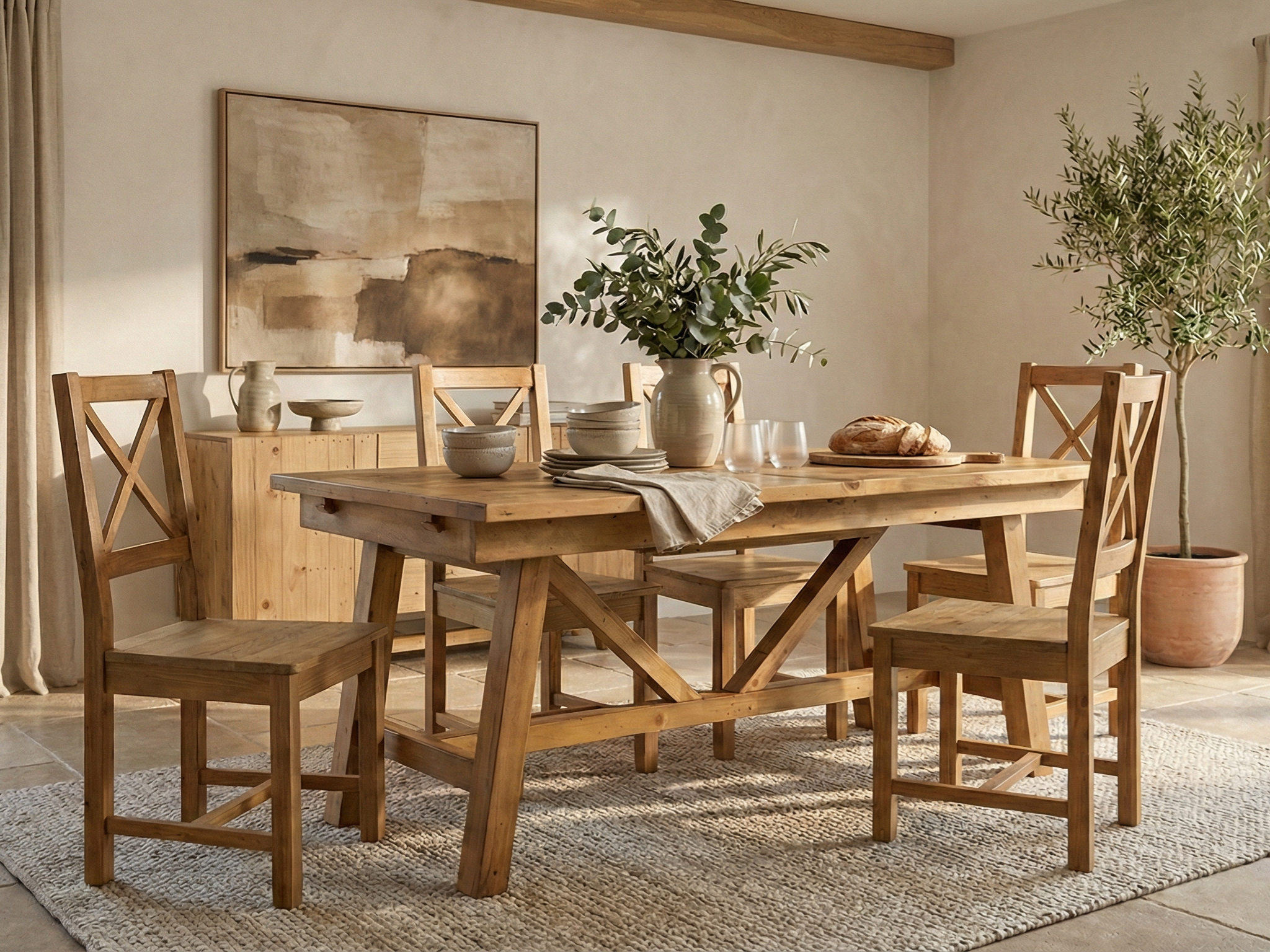


It looks like a small piece of furniture magic. A table that seats four on a Tuesday is seating eight by Saturday, and nobody has carried anything in from the garage. If you've ever wondered how extendable dining tables work, the answer is simpler than it looks, and knowing it helps a lot when you're choosing one.
Every extendable dining table relies on some kind of extending mechanism, and the type decides how the table feels to use, where the spare leaf lives, and how steady it is when open. This guide covers the main types, which suit which homes, and what to check before you buy.
How Do Extendable Dining Tables Work?
The principle is the same on every one. The tabletop splits, the two halves move apart, and an extra section fills the gap. What differs is how that extra section is stored and how the halves travel.
That leaves three things to look at. The leaf is the extra section itself. The runners, or slides, are the rails the halves move along. And the locking or alignment points hold everything level once it's open. A table that glides open and sits flat almost always has all three working well together.


Types of Extending Dining Tables and Their Mechanisms
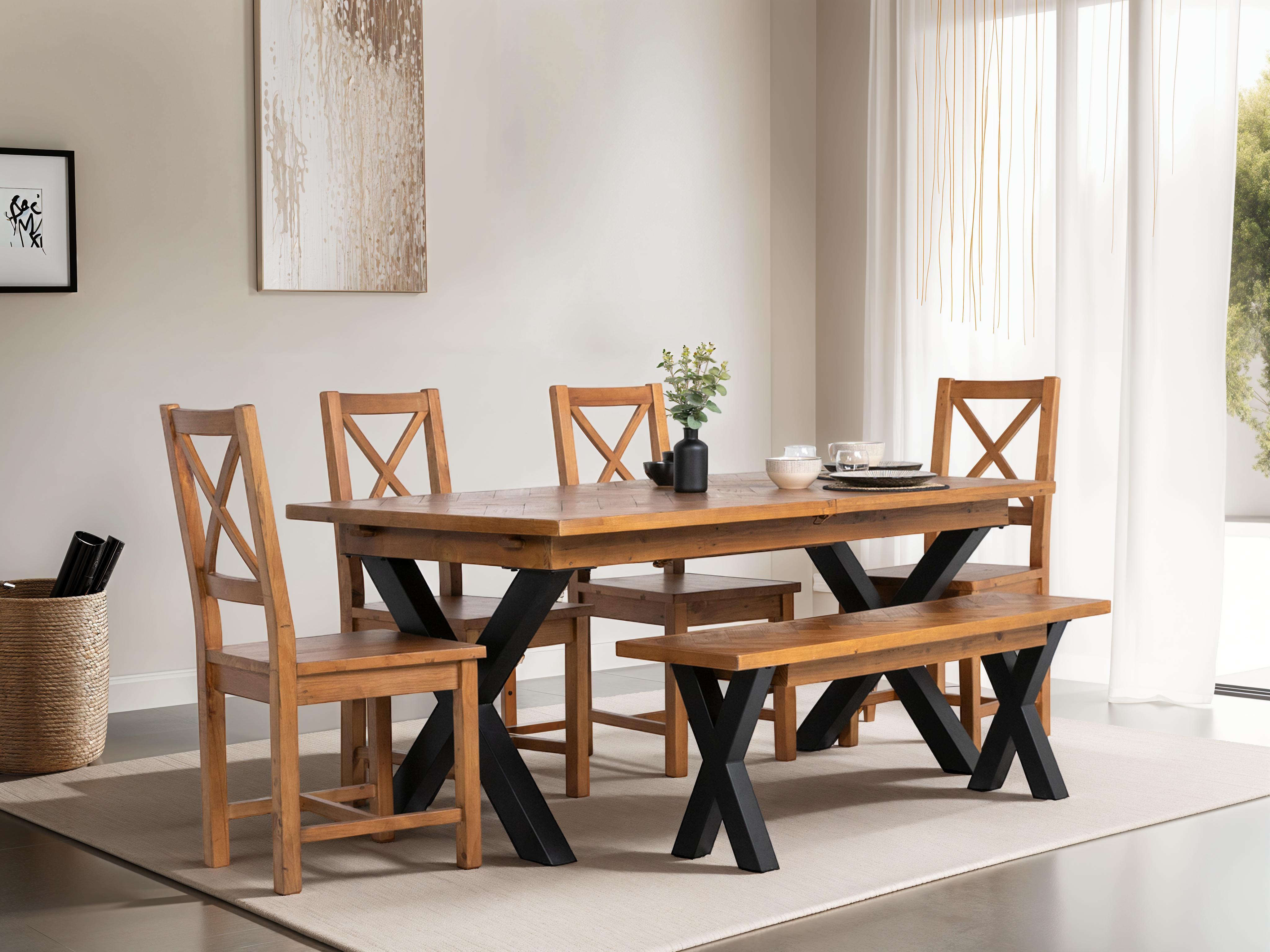
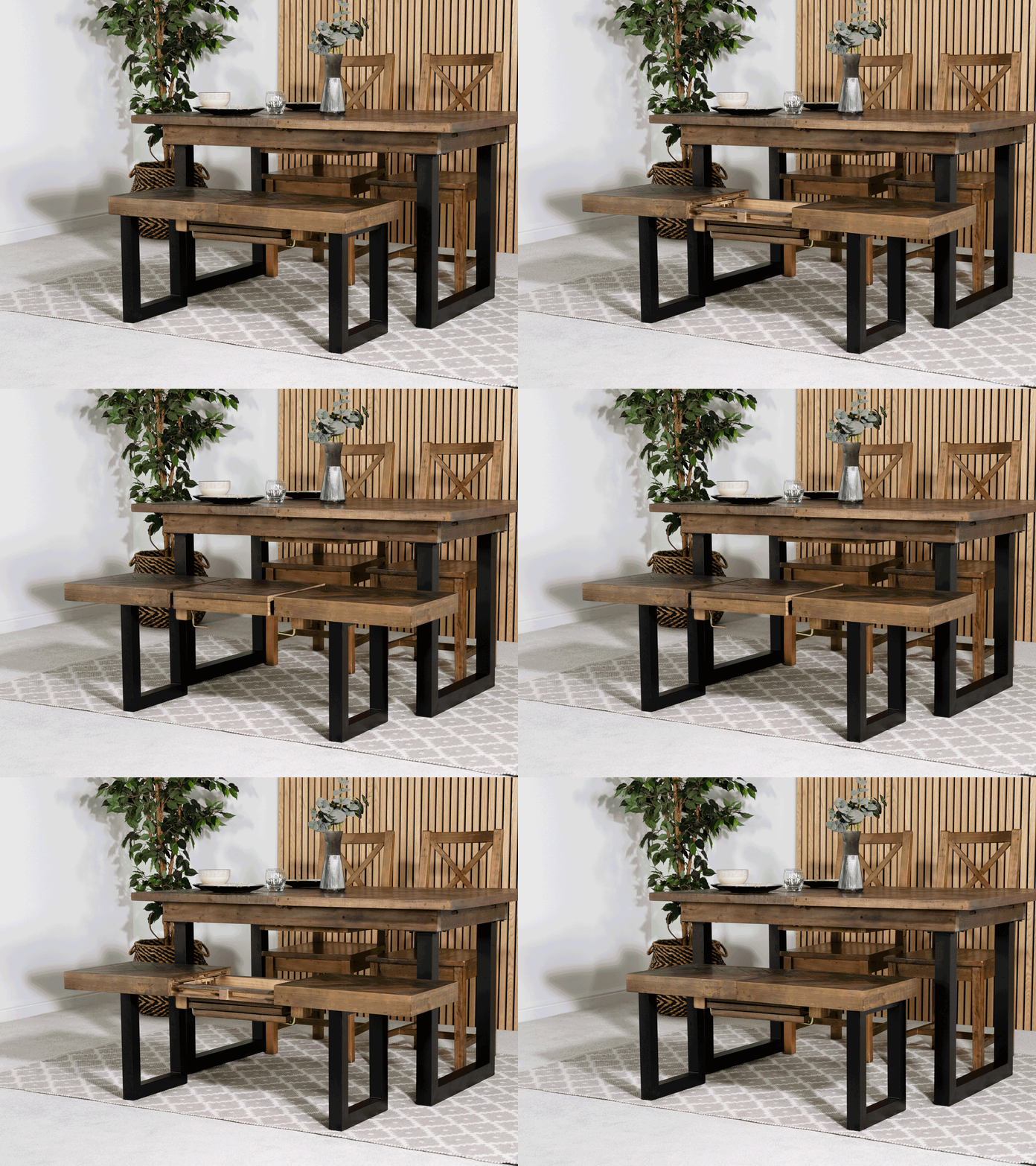
Self-storing hinged leaf. The leaf is built into the table's own frame. Closed, it sits folded down beneath the tabletop. Pull the two halves apart, and it hinges up and lies flat in the gap. This type is often called a butterfly leaf in the trade, and it's the approach used on the Brooklyn extendable table shown below, so there's no loose panel to keep track of.
Removable leaf. The traditional version. The leaf is a separate panel you lift into the gap once the halves are apart, then take out and store when the table closes. It adds no moving parts to the top itself, and on some designs you can add more than one leaf for more length.
Draw leaf, or pull-out sliding leaf. The extra leaves are stored beneath the main top and drawn out from each end on slides, with the top then lowering or lifting into place over them. It keeps the leaves with the table and often extends in stages.
Drop leaf. The sides of the table are hinged flaps that fold down when you don't need them and lift up on a bracket or swinging leg when you do. Unlike the others, it doesn't split the top; it simply adds surface at the sides. It's the oldest idea of the lot and suits very compact rooms.
Under all of these sit the runners. They're what you're really feeling when a table opens smoothly or catches. Wooden and metal runners can both work well. What matters is how well they're made and how evenly the two halves travel apart.
A round dining table that extends follows the same logic. The circle splits across the middle, the halves move apart, and a leaf fills the gap, turning the round top into an oval. The new seats appear on the sides that have grown, so picture where your chairs will go at the larger size as well as the smaller one.
Which Extension Mechanism Suits Which Home?
The right one depends on how often you extend the table, how much room you have, and where a spare leaf could live.
If you extend it often, a self-storing leaf takes the least effort, because nothing needs fetching or putting away. That suits households whose everyday and hosting numbers keep swapping.
If you only host occasionally, a removable leaf is simple and perfectly workable, as long as you've somewhere to keep it between occasions.
If storage is tight, a mechanism that keeps the leaf with the table saves you finding a cupboard for it.
If the room is small, look at both sizes. The closed table needs to fit comfortably in daily use, and the open one needs clearance for chairs and for walking around it.
Not every household needs the flexibility at all. If the number around your table barely changes, a fixed top dining table gives you one set size and nothing to operate, and our fixed top dining table size guide covers seating and clearances for that route. For households that are growing, our piece on why extendable dining tables suit growing families goes into that side of the decision.
What Makes an Extending Table Stable When Open?
An extension should do more than add surface. The table should feel as steady open as it does closed.
Stability comes from the whole build: the frame, legs, joints, and how the sections connect, not the leaf alone. With reclaimed timber furniture, the quality of the construction matters just as much as the material itself. At Reclaim Nation, our pieces are built primarily from pine and elm, salvaged from old floorboards, pallets, railway sleepers, and manufacturing offcuts, and finished by hand in our Bristol workshop.
If you can try one in person, open it and put a hand on each end. Does the top sit level where the leaf meets the halves? Does anything flex or rock when you lean on it? Do the legs stay clear of where chairs will sit? You'll learn more in a minute of that than from a spec sheet.
Where Do Extension Leaves Go When the Table Is Closed?
This is the question that catches people out. With a self-storing hinged leaf, the answer is nothing to plan for, since it folds away under the top. With a removable leaf, you need a home for it.
Choose somewhere dry, flat and out of the way of knocks, heat and damp, and follow the maker's storage guidance if they give any. Do it before the table arrives, because a leaf with nowhere to go tends to end up behind a door, and a table that's awkward to extend gets left at one size.

Brooklyn Extendable Dining Table (180cm - 240cm)
What to Check Before You Buy an Extendable Dining Table
Measure both sizes. Check the closed and fully extended length, width, and height, with space for chairs to pull out and people to move around.
Size it for everyday life. Pick the table that works on an ordinary week, then let the extension cover the occasions.
Check who will extend it. Can one person manage it comfortably, and is the mechanism easy to reach?
Look at the seam. The leaf should sit flush with the top, with no step you can feel under a plate.
Plan the seating. Chairs work well, and a dining bench along one side copes easily when numbers change. Our extendable dining benches are built to extend, which helps keep the seating in proportion when the table is open.
After nearly 30 years of designing and selling furniture, we've seen that the tables people keep for decades are the ones that are easy to use. An easy table gets extended when it's needed, and that's what makes it earn its place in a home rather than being replaced when life changes shape.
Frequently Asked Questions on Extendable Dining Tables
How do extendable dining tables work?
The tabletop splits into two halves that move apart on runners, and an extra leaf fills the gap. How the leaf is stored and put into place depends on the mechanism.
What are the main types of extending dining tables?
The most common are the self-storing hinged leaf (often called a butterfly leaf), the removable leaf, the draw leaf, and the drop leaf. All of them add length or surface, and they differ in how the extra section is stored.
Is a butterfly leaf the same as a removable leaf?
No. A butterfly leaf is built into the table and folds away beneath the top, while a removable leaf is a separate panel that you store elsewhere.
Where do you store the leaf on an extendable table?
On our Brooklyn extendable design, the leaf is hinged into the frame and folds away under the top, so there's nothing to store. If a table has a separate leaf, keep it somewhere dry, flat and protected from knocks.
Are extendable dining tables as sturdy as fixed top tables?
A well-built extendable table should feel steady in both positions. Look at the frame, legs and joints as well as the mechanism, and check the top sits level when open.
Can round tables extend?
Yes. A round extendable table splits across the middle and a leaf is added between the halves, which turns the circle into an oval with room for extra seats.
Browse our full range of dining tables to see how the different sizes and shapes would sit in your room, each one handmade from reclaimed timber.

Leave a comment
This site is protected by hCaptcha and the hCaptcha Privacy Policy and Terms of Service apply.