






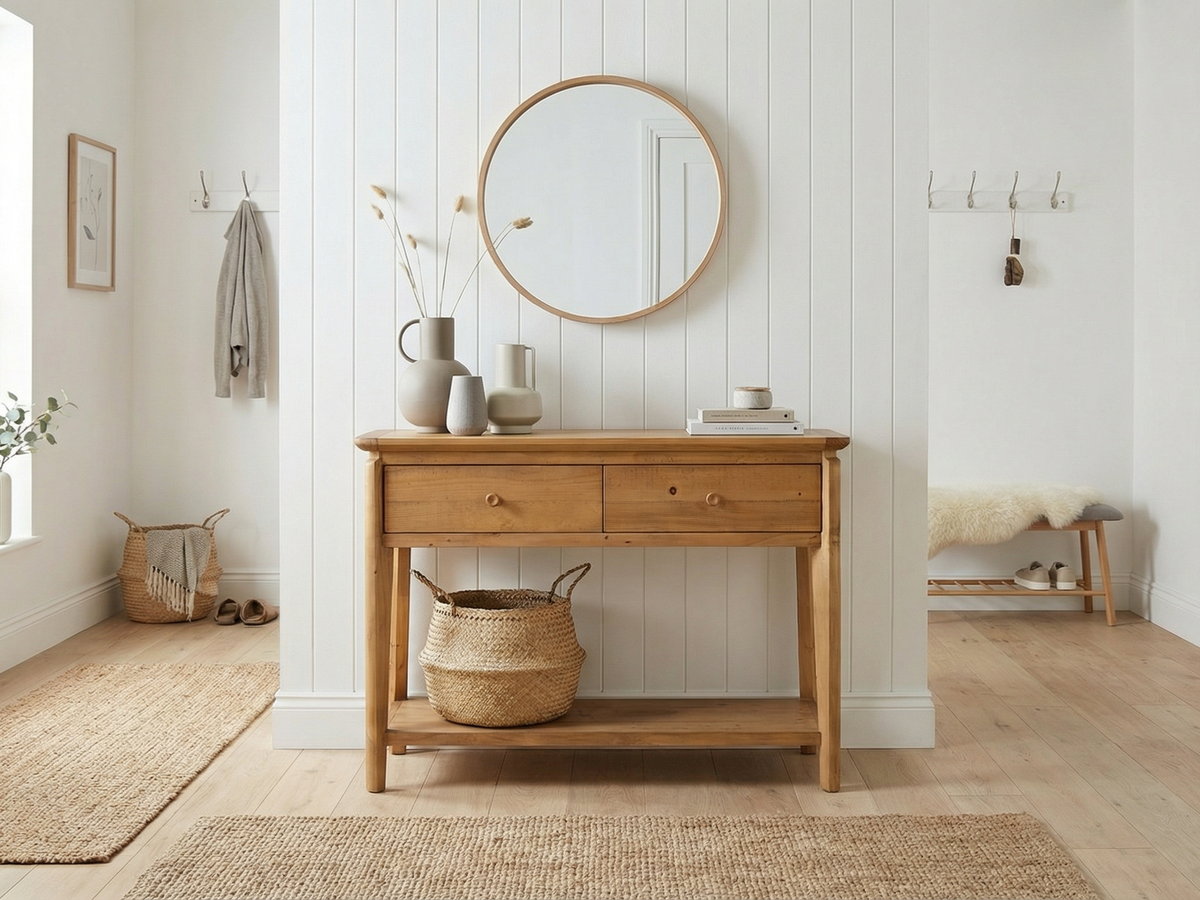
Most people choose a console table by eye, then discover in the hallway that it's five centimetres too deep. A console is meant to be slim, but slim is a relative word. What really matters is how much floor is left once it's standing there.
This console table size guide covers the dimensions that decide whether one works: width, depth and height. Then it moves on to the part that catches people out, which is how much space to leave so a hallway still works when you're carrying shopping, a pushchair or an armful of coats.
What Console Table Dimensions Work Best?
There's no single correct size, because a console in a narrow terrace hallway has a different job from one behind a sofa. As a rough starting point, most are around 75cm to 85cm high, 20cm to 40cm deep and anywhere from 60cm to 120cm wide. These are general ranges rather than fixed rules, so always check the measurements of the actual piece.

| Where it goes | Typical height | Useful depth | Width guide |
|---|---|---|---|
| Narrow hallway | 75-85cm | 20-30cm | 60-90cm |
| Wider entrance hall | 75-85cm | 30-40cm | Half to two-thirds of the wall |
| Behind a sofa | Level with, or just below, the sofa back | 25-35cm | Two-thirds to three-quarters of the sofa |
| Under a window | Below the sill | 25-40cm | Leave a gap at each end |
How Wide Should a Console Table Be?
Width decides how balanced a wall looks. A table that's too narrow looks lost on a long wall, and one that runs wall to wall can feel like a built-in you didn't plan.
Aim to cover roughly half to two-thirds of the available wall, leaving a visible gap at each end. On a 180cm wall, something between 90cm and 120cm usually looks right. Behind a sofa, choose a table about two-thirds to three-quarters of the sofa's length, so it reads as part of the arrangement rather than a rival to it. A 210cm sofa suits a console somewhere around 140cm to 160cm.
Then look at what's already on the wall. Light switches, sockets, radiators and door frames all take up width you can't use. Stick masking tape on the wall at the width you're considering, step back, and see how it feels. If a mirror or artwork is going above, it tends to look best at about two-thirds the width of the table.
How Deep Should a Console Table Be?
Depth is the measurement that makes or breaks a hallway. For hallway table dimensions, 20cm to 30cm is a safe range in a narrow space, and it's enough for keys, post and a small lamp. A wider entrance can take 30cm to 40cm, which suits a bowl, a bigger lamp or a couple of baskets underneath.
Be honest about what you'll actually put on it. If it's only keys and a tray, shallow is perfectly practical. If you want to display a large lamp or store things, check the surface can hold them without anything hanging over the edge. And when you need real storage, a deeper sideboard may suit a wider hallway, landing or dining room better than a console stretched beyond its job.
Console Table Height
Most consoles sit at roughly 75cm to 85cm, which puts the top at a comfortable height for dropping keys or setting down a bag without bending. The exact number depends on what's around it.
Behind a sofa, measure the sofa back frame rather than the cushions, which compress and shift. The console should sit level with the frame or a few centimetres below, so the two lines meet neatly. Leave a gap of 5cm to 10cm between the two so nobody catches their hand when sitting down.
Under a window, check the sill height and whether there's a radiator beneath it. A console that's too tall blocks the light, and one pushed against a radiator can trap heat against the timber.
Under a mirror, leave around 15cm to 25cm between the tabletop and the frame, so the table and mirror feel connected without anything on the surface touching it.
In older UK homes, uneven floors are common, so measure where the table will actually stand. Adjustable feet help if the floor slopes.
Hallway Clearance: How Much Space Should You Leave?
A console should make a hallway more useful, not turn it into an obstacle course. As a planning starting point, around 90cm of clear walking space is comfortable in a main hallway, enough to pass someone or carry something bulky without turning sideways. Tighter homes will have less to play with, so what matters is whether everyone who uses the space can still get through easily and every door opens fully.
Here's a quick example. If your hallway is 120cm wide and the console is 30cm deep, you have 90cm left. In a hallway only 100cm wide, the same table leaves 70cm, and you'd want to think hard about pushchairs, bags and how busy the space gets. Measure the narrowest point of the hallway, not just the wall where the table will sit.
The tape measure shouldn't stop at wall-to-wall width, though. Open every nearby door fully, including the front door, and check none of them hit the table. Look at radiators, the bottom of the stairs and skirting boards, which can hold a table slightly away from the wall and add to its effective depth. If the console has drawers, make sure they can open without blocking the route.
If the numbers say your hallway is too narrow for even a slim piece, a wall-mounted shelf may be the more sensible choice. It's much better to find that out with a tape measure than after delivery.
Console Tables Beyond the Hallway
A console isn't confined to the front door, and the sizing logic shifts a little by room. Behind a sofa in an open-plan living room, height and length matter more than depth, since the table is mostly there to frame the seating and hold a lamp or two. Against a dining room wall, it can carry serving dishes without taking the floor space a bigger piece would.
If you're furnishing the whole room, think about how the console relates to the tables around it. A deep console behind a sofa takes space away from a coffee table in front of it, while a slimmer one keeps the seating area open. It also helps to check lamp scale. Lamp tables and a console both carry lamps, and the shades shouldn't sit at awkwardly different heights or stick out into a walkway.

Sizing a Reclaimed Wood Console Table
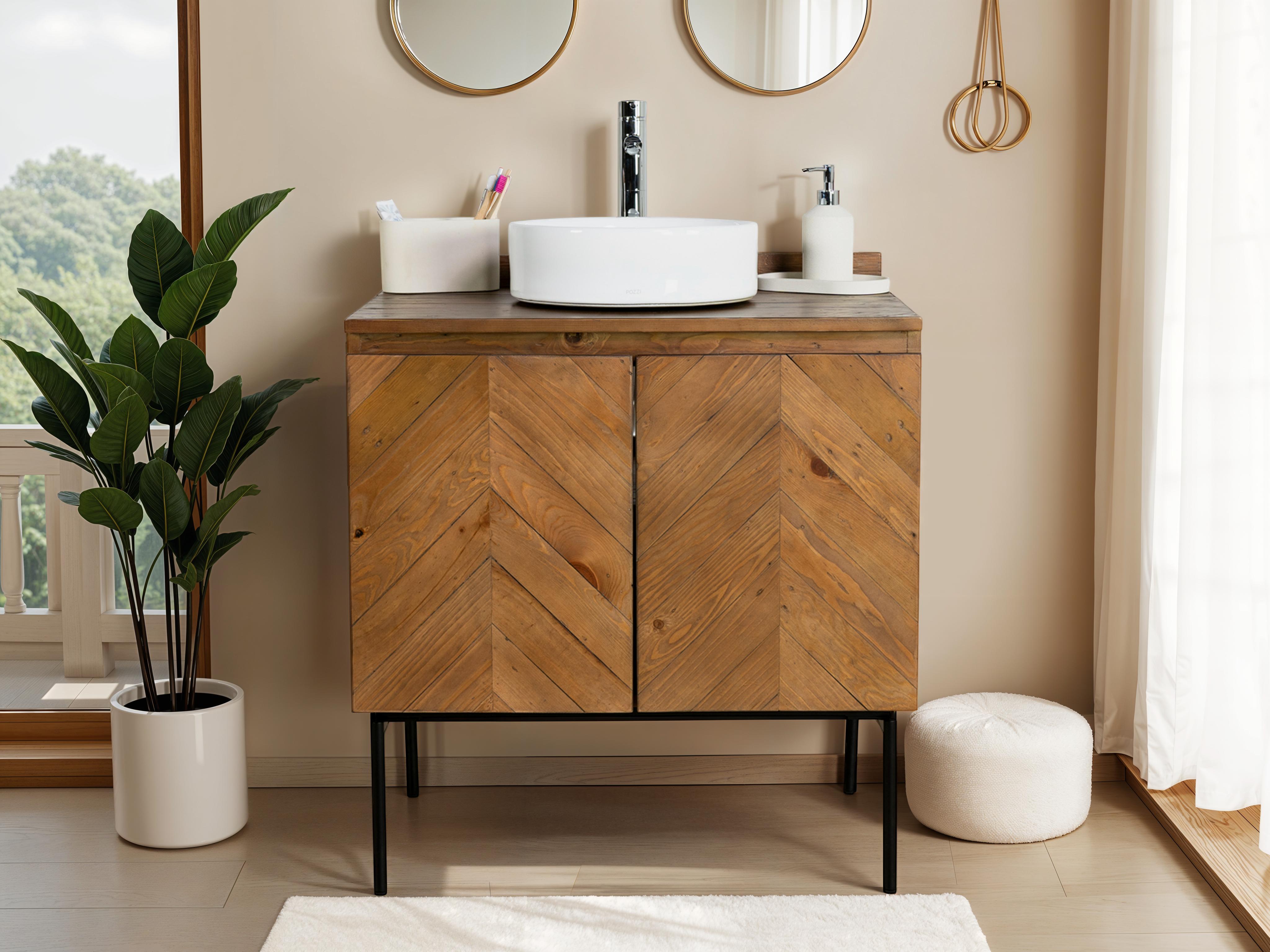
Reclaimed timber can look heavier than its measurements suggest. A table with a thick top, chunky legs and a lower shelf has more presence than an open-frame table of the same size, so it needs a little more breathing space. That character is the point, but it's worth allowing for in a tight hall.
Visual weight is the thing to watch. A thick top, chunky legs and a lower shelf make a table feel bigger than its measurements, while a slimmer top on open legs reads lighter in the same footprint. Finish plays a part too, since a paler, hand-applied finish tends to open up a small hall more than a dark one.
At Reclaim Nation, our furniture is built primarily from pine and elm, salvaged from old floorboards, pallets, railway sleepers and manufacturing offcuts, and finished by hand in our Bristol workshop. After nearly 30 years of designing and selling furniture, we know a console is one of the pieces that takes the most knocks, so it helps to choose a solid piece and to size it with a little room to spare.
For more on how reclaimed timber holds up, our comparison of reclaimed wood vs new wood furniture goes into it in more detail, and our care guide covers keeping a hallway top looking its best.
Test the Size Before You Buy
The simplest check is also the best one. Mark the table's footprint on the floor with masking tape, tape its height on the wall, and live with it for a day or two. Walk past it carrying a bag. Open the doors. Put a lamp and a bowl on a box at the right height and see if the space still feels easy to use.
Before you commit, run through this list:
- Measure the wall width and note any switches, sockets or radiators
- Measure the narrowest point of the hallway
- Subtract the table's depth to see how much walkway remains
- Open every nearby door and drawer fully
- Check the delivery route through doorways, stairs and corners
- Walk the taped footprint at a busy time of day
One more thing: don't pick the largest size that technically fits. A console should leave the room feeling finished, not harder to use. If the taped outline already feels in the way, trust that.
Frequently Asked Questions on Console Table Sizes
What size console table do I need for a narrow hallway?
A depth of 20cm to 30cm is a useful starting point, as long as you can still pass comfortably and open every door fully. Width is more flexible, provided the table doesn't run into doors, switches or radiators.
What are standard console table dimensions?
Many are around 75cm to 85cm high, 20cm to 40cm deep and 60cm to 120cm wide, though sizes vary. Treat these as a starting point and check the actual measurements of any piece you're considering.
How much space should I leave around a console table in a hallway?
Around 90cm of clear walkway is a good planning starting point in a main hallway. In a tighter space you may have less, so check that people can still pass comfortably and that doors open fully.
How wide should a console table be on a wall?
Roughly half to two-thirds of the wall width tends to look balanced, with a visible gap at each end. Behind a sofa, two-thirds to three-quarters of the sofa's length works well.
How tall should a console table be behind a sofa?
Level with the sofa back frame, or a few centimetres below it. Measure the frame rather than the cushions, as cushions compress and move.
Is a slim console table better for a small hallway?
Often, yes. A shallower table takes less floor space, but it still has to be deep enough for what you want to put on it, so measure the hallway first and decide how you'll use the surface.
Ready to find the right fit for your home? Compare the dimensions of our console tables with your own measurements before choosing a design for your hallway or living space.

Leave a comment
This site is protected by hCaptcha and the hCaptcha Privacy Policy and Terms of Service apply.